
July 19, 2026
Rockets Are in the News Again. Your Kid Should Meet the Man Who Started It.
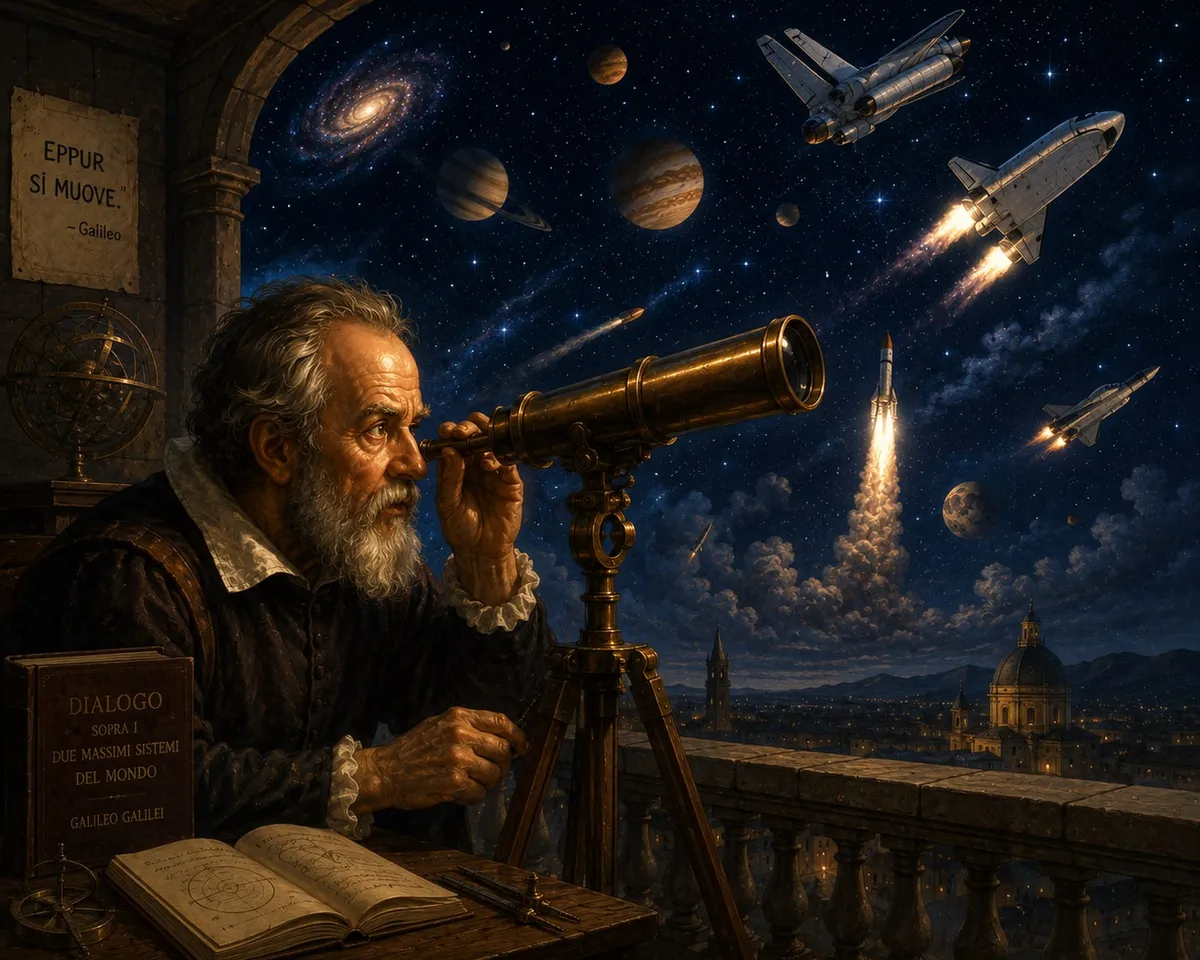
Space is back in the headlines almost weekly. Rockets landing upright like something out of a cartoon, private crews going up, telescope images of galaxies that formed before our sun existed.
My son watches the launch clips the way other kids watch football highlights. Which I’m pleased about, except that the clips give him the ending and none of the story, and the story is the interesting part.
Somebody had to think the thought first, and he did it with a tube and two bits of glass.
He never saw the invention he improved
In 1609 Galileo heard that someone in the Netherlands had made a spyglass that brought distant things closer. He never got to examine one. He worked from a description, essentially a rumour, and built his own.
Then he kept improving it until it magnified about twenty times, which was far beyond anything else in existence at the time. He sold the design to the Venetian senate, who were delighted, because they were thinking about ships on the horizon.
Then he did the thing almost nobody had bothered to do. He turned it upward.
Four dots that broke the universe
January 1610. Galileo noticed four faint points of light near Jupiter and assumed they were small stars.
He looked again the following night. They’d moved. He looked the night after that, and the night after, and kept notes, and realised what he was seeing: four moons, going around a planet that wasn’t Earth.
At the time, everyone knew that everything in the sky revolved around us. That was simply the arrangement. And here was a man with a homemade tube watching four objects circle something else entirely.
He published. It went badly for him eventually. He spent his last years under house arrest for refusing to unsay it, and went blind before the end, still writing.
The bit I want my son to hear
Not the trial. Not the “and yet it moves” line, which he probably never said.
This: the equipment Galileo needed didn’t exist, so he made it. He didn’t apply for it, or wait for someone qualified, or assume that a man teaching mathematics in Padua wasn’t the right person to redraw the solar system.
Every astronaut in orbit right now is sitting on top of that.
If you read it together
Two questions that tend to open something up:
- He built it from a description he’d only heard about. What would that take?
- Everyone told him he was wrong. Why keep going?
And if your child is the sort who takes things apart to see inside, this is their person. Mine dismantled a torch at seven and could not get it back together, and I remember being annoyed about the torch, which in hindsight was the wrong thing to be annoyed about.
Galileo opens Big Names for Little Hearts, fifteen illustrated stories of scientists, explorers and thinkers for ages 8 to 12.